Measure / 002
Your phone can measure a room. Here is what it still cannot do.
Scanning is genuinely good, and genuinely limited, and the limits are not where most people assume.
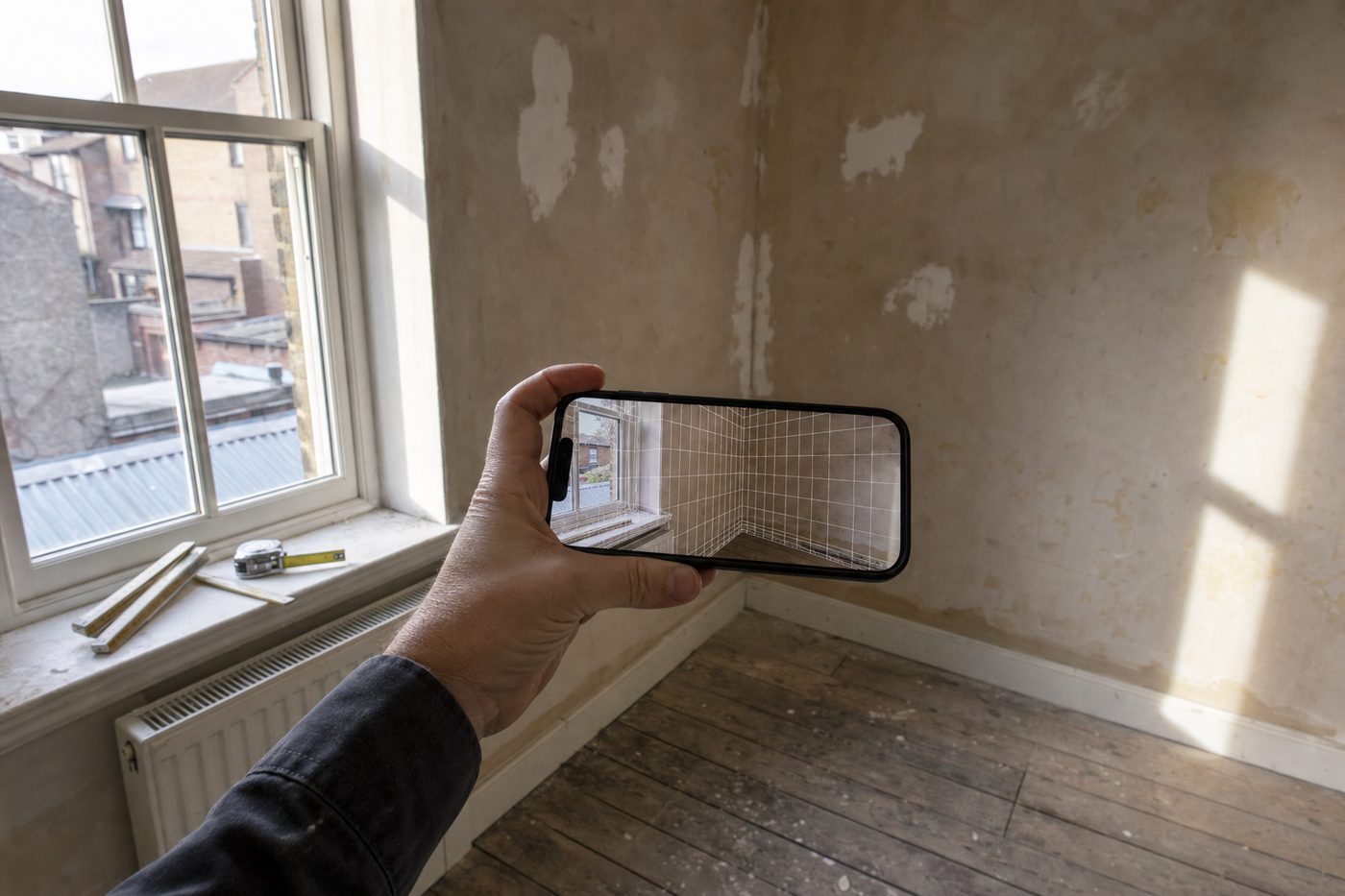
A phone with a depth sensor will now walk you round a room and hand back a floor plan in about ninety seconds. Walls, openings, ceiling height, area. It is not a toy and it is not a gimmick. Ten years ago that was a morning's work with a laser and a clipboard.
So the interesting question is not whether it works. It is what the result is good enough for, which is a different question and one the app never asks you.
What a scan is genuinely better at
It does not forget. This is the real advantage and it is bigger than the speed. A tape measure records what you thought to write down. A scan records the room, including the parts you had no reason to care about until three weeks later when you do. Nobody has ever driven back across town because the scan left something out.
It captures shape faster than you can describe it. A bay, a canted corner, a chimney breast with a shallow return either side. Those take real effort to record by hand and no effort at all to scan.
It gives you the room when you are not in it. Which matters more than it sounds, because most planning happens somewhere else, weeks later.
Where it stops
Tolerance. Consumer scans land within an inch or two over a room, sometimes better, occasionally much worse. For deciding whether a sofa fits, that is fine. For anything built to fit an opening it is not. Half an inch across a twelve-foot cabinet run is a scribe you can hide. Two inches is a run that does not go in.
It only measures what it can see. Behind the radiator, under the worktop, the wall behind the fridge, the inside of the cupboard under the stairs. A scan is a record of surfaces in line of sight, and the parts it cannot see are precisely the parts that surprise people.
It measures finish, not structure. You get the face of the skirting, not the face of the wall. You do not get which wall is holding something up, where the joists run, whether that wall is plumb, or how much of the opening is frame and how much is glass.
It does not know what matters. This is the one that costs money. A scan hands you every surface at equal weight. It will not tell you that the ceiling drops four inches at one end, that one window head sits lower than its neighbour, or that the floor falls half an inch toward the bay. All of that is in the data. None of it is flagged, because the instrument has no opinion.
Every instrument since the plumb bob has been able to capture more than the person holding it can judge. That gap is the job.
The ten minutes that make a scan trustworthy
This is the part worth taking away, and it is the same discipline that made a tape reliable.
Scan the room for shape. Then take control dimensions by hand. Four of them, and no more:
- Overall length and overall width, wall face to wall face.
- Both diagonals, corner to opposite corner, which tells you whether the room is square and by how much.
- Ceiling height at two opposite corners, not one.
- Every opening located back to a corner, not merely sized.
Then check those four against the scan. If they agree, trust the scan for everything else. If they do not, you have learned the thing the scan could never tell you: how far off it is, and in which direction. Either answer is worth having, and both take ten minutes.
That is not scepticism about the technology. It is the ordinary practice of establishing control before you trust a survey, which is older than any of the instruments involved and has survived every one of them.
Scanning well, since you are going to
Move slowly and evenly, at a walking pace you would find annoyingly slow. Turn the lights on, all of them. Open every door and cupboard you want recorded. Pull furniture off the walls if you can, because the scan will happily record your sofa as architecture. And do a second pass in the opposite direction, which costs ninety seconds and catches most of what the first one missed.
What actually changed
Capture got faster, cheaper and far more complete. That is a real change and it is worth using.
What did not change is that a measurement still has to be located, a survey still has to be controlled, and somebody still has to decide which of the several thousand numbers now in your pocket are the ones the job depends on. The scan made the first part nearly free. It made the second part more valuable, not less, because there is now far more data and exactly as much judgment as there ever was.
The old skill was getting the numbers. The new skill is knowing which ones you are willing to build to.
The control dimensions, on paper
Home Measure
The free four-page checklist is the by-hand half of this: the four control dimensions, every opening located back to a corner, and the nine photographs. Take it with you whether or not you scan.